

Most people assume the answer is a simple yes or no. It is neither. In the UK, selling sex is legal, and so is paying for it in most of the country, yet a whole ring of activities around it are criminal offences. That gap is where people get caught out.
Search "is escorting legal uk" and you will find forum threads that contradict each other, half-remembered pub wisdom, and blog posts that quote laws repealed a decade ago. The confusion is understandable. UK prostitution law is a patchwork built over 70 years, and it treats the act itself very differently from everything that surrounds it.
This guide clears it up. You will learn what is legal for both buyers and sellers, which related activities are offences, how the rules shift between England, Wales, Scotland, and Northern Ireland, and where the real legal risk sits. No jargon left unexplained, no scare tactics.
Not legal advice: This article is educational only. It is a plain-English overview, not legal advice. Laws change and every situation is different. If you need guidance on your circumstances, consult a qualified solicitor.
The short answer: escorting itself is legal
Here is the core of it. In England, Wales, and Scotland, selling sexual services is legal. There is no law that makes being an escort or a sex worker a crime. Buying sexual services is also legal in those three nations, with one important exception covered below.
So when people ask "is escorting legal," the honest answer is that the exchange of money for sex between two consenting adults is not, in itself, an offence anywhere in Great Britain.
What is illegal is a cluster of surrounding activities: running a brothel, soliciting in a public place, kerb-crawling, controlling someone's work for profit, and paying for sex with a person who has been coerced. UK law does not target the act. It targets exploitation, public nuisance, and third-party profit.
That distinction matters enormously in practice. Two people can meet legally, but the moment a third person profits from arranging it, or the activity spills into a public street, the picture changes.
If you are researching this so you can browse or post ads responsibly, it helps to start on a moderated platform where listings are checked before they go live. You can browse escort ads on Erowave to see how verified, compliant listings are presented.
What is legal vs illegal: the quick reference
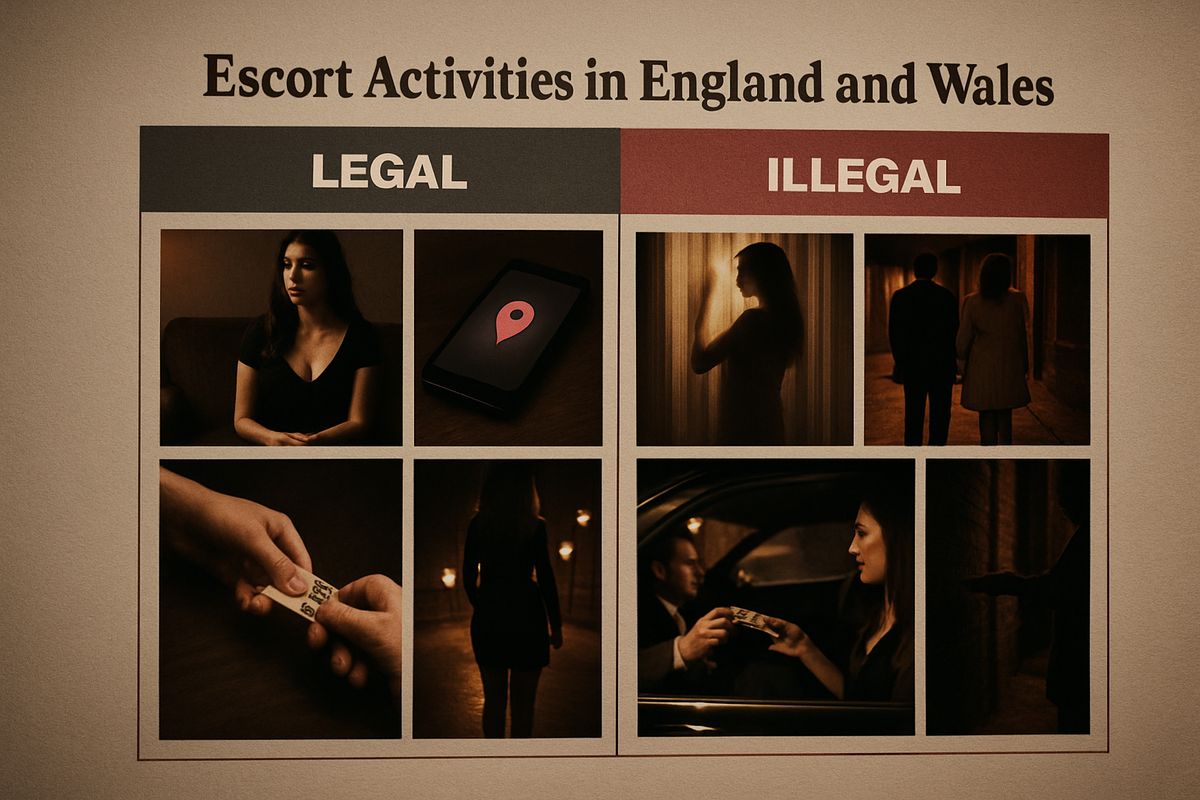
The table below summarises the position in England and Wales, which is where most UK searches originate. Scotland and Northern Ireland differ on specific points, covered in the next section.
| Activity | Legal status (England & Wales) |
|---|---|
| Selling sexual services (being an escort) | Legal |
| Paying for sex with a consenting adult | Legal |
| Advertising services online (your own) | Legal, with limits |
| Working alone from your own premises | Legal |
| Two or more sex workers sharing premises | Illegal (counts as a brothel) |
| Keeping, managing, or assisting a brothel | Illegal |
| Soliciting or loitering in a street or public place | Illegal |
| Kerb-crawling / soliciting sex in public | Illegal |
| Controlling prostitution for gain | Illegal |
| Causing or inciting prostitution for gain | Illegal |
| Paying for sex with a coerced person | Illegal (strict liability) |
| Placing adverts in phone boxes | Illegal |
Keep this framing in mind: the act is legal, the surrounding structure is heavily regulated. Almost every UK prostitution offence exists to stop a third party profiting, to stop coercion, or to stop public nuisance.
The offences that make the difference
This is the part that actually matters. The legality of escorting hinges on avoiding a specific set of offences. Here is what each one means in plain terms.
Brothel-keeping
A brothel is not what most people picture. In UK law, premises count as a brothel if more than one person uses them for prostitution, even without a manager. Keeping, managing, or acting in the management of a brothel is an offence under the Sexual Offences Act 2003 and earlier legislation.
The practical effect surprises people. A sex worker operating alone from their own flat is working legally. But if two workers share that flat for safety, the premises technically become a brothel, and that is the brothel keeping law UK enforcement most often cites. It is one of the most criticised features of the current framework, precisely because it pushes people to work alone.
Consider Hannah, a 29-year-old escort in Manchester. She worked solo from a rented flat, entirely within the law. When a friend suggested they share the place to split costs and watch out for each other, Hannah looked into it and discovered that the arrangement would expose them both to a brothel-keeping charge. She kept working alone instead, a choice the law effectively forced on her.
Soliciting and loitering
The soliciting law targets public spaces, not the act itself. Under the Street Offences Act 1959, it is an offence for a person to loiter or solicit in a street or public place for the purpose of prostitution. On the buyer's side, soliciting someone in a public place for sex, commonly known as kerb-crawling, is an offence under the Sexual Offences Act 2003.
The logic is public nuisance. The law is not trying to stop the transaction, it is trying to keep it off the streets. Arrange a meeting privately and discreetly online, and this offence is not in play.
Controlling and inciting for gain
Controlling prostitution for gain and causing or inciting prostitution for gain are serious offences under the Sexual Offences Act 2003. These are the laws aimed at pimps, managers, and anyone who directs or profits from another person's sex work.This is where the line between a legitimate service and an offence gets sharp. A platform that simply hosts classified ads is very different from a person who controls a worker's activity for their own profit. The offence is about control and coercion, not about advertising space.
Paying for sex with a coerced person
This is the single most important offence for buyers to understand. Under changes introduced by the Policing and Crime Act 2009, it is a strict liability offence to pay for the sexual services of a person who has been subjected to force, threats, coercion, or deception by a third party.
Strict liability means it does not matter whether you knew. If the person was coerced, the buyer commits an offence regardless of intent or awareness. That is why using verified, moderated platforms and staying alert to red flags is not just good practice, it is legal self-protection.
England & Wales vs Scotland vs Northern Ireland
The UK is not one legal jurisdiction, and prostitution law is one of the clearest examples. Here is how the picture shifts across the four nations.
England and Wales
Everything above applies here. Selling and buying sex are legal. Brothel-keeping, soliciting, kerb-crawling, and controlling for gain are offences. This is the framework most "escort laws uk" searches are really asking about.
Scotland
Scotland takes a broadly similar approach with its own statutes. Selling sex is legal, but soliciting in a public place is an offence under the Prostitution (Public Places) (Scotland) Act 2007, which applies to both buyers and sellers. Brothel-keeping and living off the earnings of prostitution remain offences. The practical position closely mirrors England and Wales, even though the specific laws differ.
Northern Ireland
Northern Ireland is the outlier, and the difference is fundamental. Since 2015, under the Human Trafficking and Exploitation Act (Northern Ireland) 2015, it is a criminal offence to pay for sexual services. This is the so-called Nordic or Swedish model.
So the answer to "is paying for an escort legal" flips depending on which side of the Irish Sea you are on. In England, Wales, and Scotland, paying is generally legal. In Northern Ireland, the buyer commits an offence, while the seller does not.
Take James, who moved from Leeds to Belfast for work. He assumed the sex work law UK-wide was uniform. It is not. In Leeds, arranging a private booking with a consenting adult was legal. In Belfast, the same arrangement would make him, as the buyer, a criminal, even though the escort would not be breaking the law. The lesson is simple: jurisdiction changes the answer.
If you want to understand how a platform handles these regional differences and keeps listings compliant, the Erowave FAQ explains how moderation and safety checks work before any ad goes live.
Advertising, platforms, and the legal grey areas
Advertising sits in a nuanced space. Advertising your own services online is generally lawful, but there are limits. Placing adverts for prostitution in public telephone boxes is a specific offence under the Criminal Justice and Police Act 2001. Content that facilitates trafficking or controls another person's work crosses into criminal territory fast.
Legitimate classifieds platforms operate by hosting listings that individuals post about their own services. The key legal safeguards are moderation, verification, and clear terms that prohibit coercion, trafficking, and underage content. This is exactly why platform choice matters for everyone involved.
Erowave, for example, moderates every ad before publication, watermarks photos, and runs a reporting system for suspicious content. Those measures are not just about quality. They reduce exactly the legal risks the law is designed to catch, most importantly the risk of anyone unknowingly engaging with a coerced person. You can review how the rules are applied in the Erowave terms of service.
For anyone posting or browsing, the takeaway is consistent. Stay on platforms that verify listings, avoid anything that looks controlled or coerced, and keep everything private and consensual. That approach aligns with the law rather than testing its edges.

Staying on the right side of the law: practical points
You do not need a law degree to act responsibly. A few clear principles cover most situations.
- Work or book privately. Public solicitation is where street-level offences apply. Private, discreet arrangements online avoid that entirely.
- Understand the brothel rule. In England and Wales, one worker per premises is legal. Sharing premises for sex work is not, however sensible sharing might seem for safety.
- Never involve a third party who profits or controls. Controlling or inciting for gain is a serious offence. Genuine independence is the legal norm.
- Watch for coercion. Paying for sex with a coerced person is a strict liability offence in England and Wales. If anything suggests a person is not acting freely, walk away.
- Know your jurisdiction. In Northern Ireland, paying for sex is illegal. In the rest of the UK, it generally is not.
- Use moderated platforms. Verified listings reduce your exposure to scams, coercion, and the legal risks that come with them.
For a broader view of safe booking practices, personal discretion, and how to spot red flags, our guide to safe companion meetings pairs well with the legal picture here. And if you are ready to browse compliant, verified listings, start with companion ads in London or your own city.
The public authorities responsible for enforcement, including the Crown Prosecution Service, publish their own guidance on how these offences are charged. The law is not designed to punish consenting adults. It is designed to catch exploitation, coercion, and public nuisance, which is where enforcement attention actually goes.
Frequently asked questions
Is escorting legal in the UK?
Yes, in England, Wales, and Scotland, selling sexual services as an escort is legal. What is illegal is a set of surrounding activities: brothel-keeping, soliciting in public, controlling someone's work for gain, and paying for sex with a coerced person. In Northern Ireland, selling is legal but paying is an offence.
Is paying for an escort legal?
In England, Wales, and Scotland, paying a consenting adult for sex is generally legal. The exception is paying for sex with someone who has been coerced, which is a strict liability offence. In Northern Ireland, paying for sex is always an offence.
Why is brothel-keeping illegal if selling sex is not?
UK law treats third-party involvement and shared premises differently from the act itself. Any premises used by more than one person for prostitution counts as a brothel, so two workers sharing a flat, even for safety, can face a charge. Solo work from your own premises remains legal.
Does the law differ across the UK?
Yes. England, Wales, and Scotland share a broadly similar framework where selling and buying are legal but related activities are offences. Northern Ireland criminalises paying for sex under a Nordic-model law introduced in 2015.
The bottom line
UK prostitution law is less about the transaction and more about everything around it. Escorting itself is legal across Great Britain, and paying for it is legal too outside Northern Ireland. The offences kick in with brothels, public soliciting, third-party control, and coercion.
Here is what to carry away:
- The act is legal, the structure is regulated. Selling and buying sex are legal in England, Wales, and Scotland.
- Third-party profit and coercion are the red lines. Brothel-keeping, controlling for gain, and paying a coerced person are offences.
- Public solicitation is an offence. Keep arrangements private and discreet.
- Northern Ireland is different. Paying for sex there is always illegal.
- Platform choice is legal protection. Verified, moderated listings reduce your exposure to the exact risks the law targets.
Understanding the law is the first step to acting responsibly within it. When you are ready to explore verified, moderated listings, browse escort ads on Erowave, filter by your city, and reach out with confidence.
This article is for general education only and does not constitute legal advice. For guidance specific to your situation, consult a qualified solicitor.