


Last Tuesday, James opened an escort ad in Manchester. The photo looked perfect, studio lighting, flawless skin, a price 40% below anything else in the city. He sent a deposit in Bitcoin "to confirm the booking" and got blocked thirty seconds later. The advertiser was never real. The photo was AI-generated. The £180 was gone.
You probably already know that fake escort ads exist. What changed in 2026 is the quality of the fakes, and that is why how to spot fake escort ads is now a different skill than it was even two years ago. AI-generated photos pass a casual eye test. Scam scripts read like a friendly conversation. Premium-rate SMS short codes get buried inside "verification" texts. The old advice, "just look for typos," stopped working two years ago.
This guide gives you three things you can use right now: a tight 10-point red-flag checklist, the seven scams driving most losses in 2026, and a 5-minute verification routine that catches the majority of fakes before you send a single message. If you only have two minutes, read the checklist, bookmark the page, and come back when you have an ad in front of you.
For a wider safety overview, see our complete escort safety guide. This piece zooms in on one job only: deciding whether a specific ad is real before you ever make contact.
The 10-Point Red-Flag Checklist for Fake Escort Ads
Use this list before you message any advertiser. If two or more items match, walk away. If five or more match, the ad is almost certainly fake.
The photos return matches on reverse image search. The same face appears on three unrelated profiles, a stock-photo library, or an Instagram account in a different country.
The price is dramatically below market for the area. A £100 booking in central London is not a deal, it is a hook.
There is a demand for a deposit via gift card, crypto, wire, or Cash App. No legitimate advertiser asks for Amazon gift cards.
The advertiser pushes you off-platform within the first two messages. "Text me on WhatsApp" or "Telegram only" before you have agreed on anything is a scripted move.
Any form of live verification is refused. No selfie, no short video, no "hold up two fingers" photo on the day.
The profile has no posting history and no reviews. A brand-new account with one ad and zero ratings is a clean slate, often by design.
The description recycles generic phrases. Paste a sentence from the bio into Google. If it appears word-for-word on five other sites, it is a copy-paste template.
The photos look studio-perfect. Magazine-grade lighting, no candid shots, no mirror selfies. Real advertisers mix professional and casual photos.
The photos show AI artifacts. Warped hands, mismatched earrings, melted nails, plastic-smooth skin, or a background that does not make physical sense.
The contact number is a premium-rate SMS short code or a foreign prefix that does not match the advertised city.
Featured-snippet version of this checklist, share it, screenshot it, keep it on your phone. Most fake escort ads fail three or more of these checks in under five minutes.
Want to skip the guesswork? Browse verified escort ads on Erowave where every listing passes moderation before going live, and photos carry platform watermarks you can verify.
The 7 Most Common Escort Scams in 2026
Scams cluster around a few repeatable scripts. Once you have seen the pattern, you spot it instantly.
1. Bait-and-Switch (Catfish)
The photos show one person. A completely different person opens the door, or the meeting never happens at all. This is the original escort scam and it still works because most users do not run a reverse image search. The fix: insist on a live selfie with a specific gesture or the current date written on paper. If the advertiser refuses, you have your answer.
2. The Deposit Scam
You are told to send a "booking confirmation deposit" before the meeting. The payment method is always something irreversible, Bitcoin, USDT, Amazon gift cards, Cash App, or a wire transfer to a "personal assistant." The moment the money lands, you get blocked. Deposits, when legitimate at all, are paid through the platform, not to a random wallet address. According to the FTC, gift card and crypto fraud account for the largest single category of consumer scam losses in the United States.
3. The Premium-Rate SMS Scam
A "verification text" arrives from what looks like a normal phone number. Replying triggers a premium-rate short code that charges £3-£15 per message, sometimes more. The scam works in waves across the UK and EU and rarely gets covered in escort-safety content because it looks technical. The tell: any "verification SMS" that asks you to text back to confirm. Real verification flows do not bill you for replies. If you suspect a premium-rate trap, check Citizens Advice or your carrier's short-code list before responding.
4. The Cartel / Blackmail Scam
A scripted threat lands in your inbox or by phone. The "advertiser" claims to be connected to a cartel, says you "wasted her time," and demands Bitcoin to avoid consequences. The script is identical across hundreds of victims, sometimes word for word. It is always fake. Do not pay, do not negotiate, do not reply. Document everything and report to IC3 or Action Fraud. Engaging the scammer only confirms the channel works.
5. Fake Law Enforcement Extortion
The phone rings. The "caller" claims to be a detective who saw you contact a minor through an ad. They want a "settlement" in crypto or gift cards to make the case disappear. No real law enforcement officer demands payment over the phone. Hang up. The script is recycled from generic IRS and police-impersonation scams; the escort framing is just a new coat of paint.
6. Sextortion via Recorded Calls
You start a video call. The other side is recording from frame one, screen-capturing your face, your room, sometimes your screen. After a few minutes the threats arrive: pay or the recording gets sent to your contacts. A second wave follows, "recovery experts" who claim they can delete the footage for a fee. They cannot. Never pay either party. The second scam, the recovery service, is itself documented by the FBI as a follow-on fraud targeting victims of the first.
7. Fake Agency Websites and Cloned Listings
A polished agency site lists 30 escorts with prices, reviews, and contact forms. The site is a clone, the photos stolen, the contact form a malware delivery system. Cloned listings also appear across multiple platforms with identical bios and the same three photos. If the same profile shows up on four sites with four different names, it is a recycled scam asset.
Mike's near-miss: Mike in Birmingham contacted what he thought was a verified independent. The site looked clean, the photos were striking, and the bio was warm. A reverse image search on the first photo returned 17 matches across three countries, the same face advertised in Madrid, Vienna, and Toronto. He closed the tab. Total time: 90 seconds.
Photo Red Flags in Fake Escort Ads: Stolen, Stock, and AI-Generated Images
Photos are the easiest part of an ad to fake and the easiest part to verify. Three checks, five minutes, done.
How to Run a Reverse Image Search in Under 5 Minutes
You do not need a paid tool. You need three free ones, used in order.
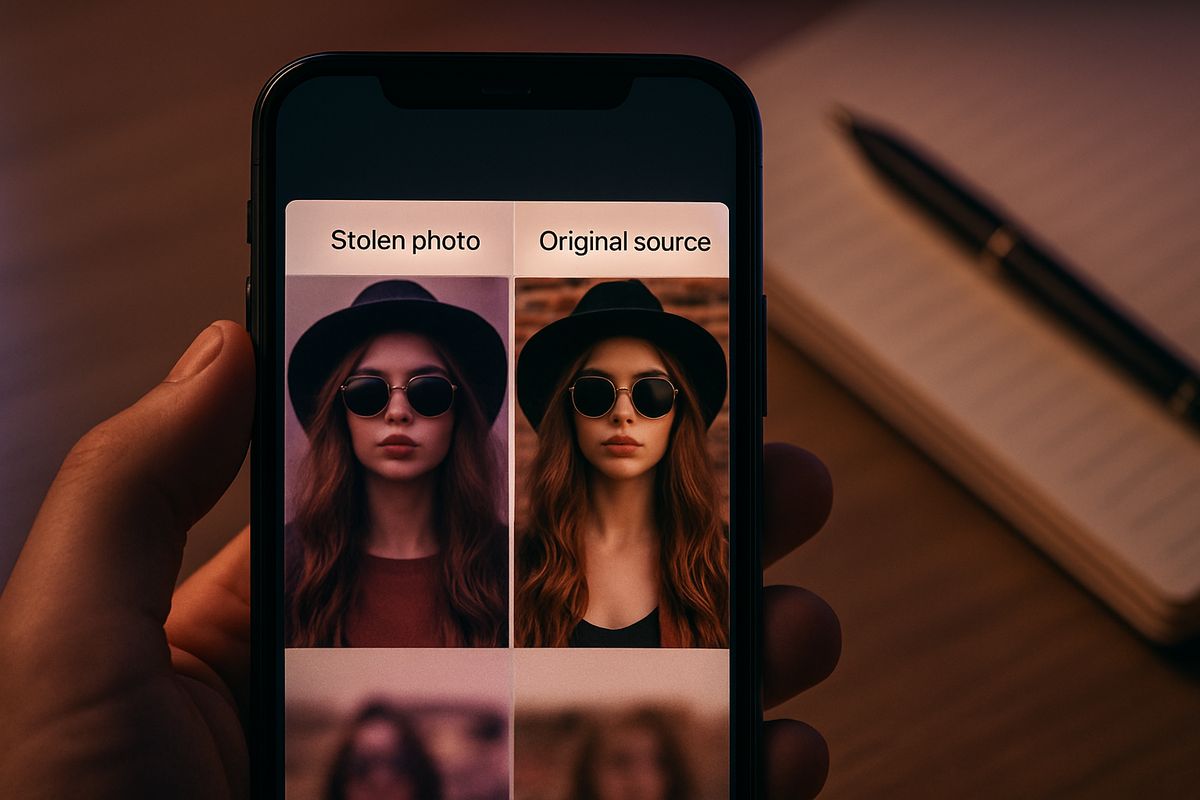
Google Lens is the fastest first pass. On a phone, long-press the photo and tap "search with Google." On desktop, drag the image into images. google.com. You are looking for the same face appearing on stock libraries, social media, or escort ads in other cities. TinEye specializes in first-seen dates and exact-image matches. Drop the image at tineye.com. If a photo "first appeared" on a stock site in 2019, the ad is using stolen content. TinEye is also strong at catching cropped or mirrored versions of the same image. Yandex Images is the best free tool for face matching, and most safety guides skip it. The Russian search engine indexes faces aggressively and catches matches that Google misses, especially on lesser-known social profiles. Upload the photo at yandex.com/images and scroll the "similar faces" section.
A real result: one or two matches, usually on the advertiser's own profiles. A fake result: many matches across unrelated names, stock sites, or AI image galleries.
Stock-Photo Tells
Studio lighting that looks like a magazine cover. No environmental clutter. No mirror selfies. Identical poses found across multiple ads. A faint watermark ghost in the corner where someone tried to crop out a logo. Real advertisers post a mix, professional shots and candid phone photos, because they need to look like a real person, not a brand campaign.
Spotting AI-Generated Photos
AI image tools improved dramatically through 2024 and 2025, but they still leave fingerprints. Train your eye on these:
Asymmetric earrings or eyes. Different shapes, different sizes, or only one earring rendered.
Distorted hands. Six fingers, melted nails, fingers that bend the wrong way.
Plastic skin. Uncanny smoothness, no pores, no asymmetry, no shine.
Jewelry that melts into clothing or skin. Necklaces that disappear mid-strand, rings fused to fingers.
Backgrounds that do not make sense. Doors that lead nowhere, mirrors that reflect the wrong scene, furniture that warps near the edges.
Uncanny symmetry. Real faces are slightly asymmetrical. AI faces are often eerily balanced.
When you are unsure, run the photo through a free AI-detection tool like Hive Moderation or Sightengine. They are not perfect, but they catch the obvious ones. A photo flagged as 80%+ AI-generated is a hard pass.
Communication and Pricing Red Flags
Even when photos check out, the conversation often gives the scam away.
Communication Tells
Off-platform pressure. Within two or three messages, the advertiser wants WhatsApp, Telegram, or Signal. Real conversations can move to other apps eventually, scams need to move fast because the platform's moderation will flag the account. Refusal to verify live. Ask for a 10-second selfie holding two fingers or the day's date. Real advertisers send it in under a minute. Scammers stall, change the subject, or claim "policy" reasons. Inconsistent language. Paragraph one reads like a copy-paste template. Paragraph two has different grammar, different tone, sometimes a different language register entirely. You are talking to a script and then a person, or to two different people. Urgency. "Only tonight." "Last slot." "Deposit in the next 20 minutes or I move to the next client." Urgency is the oldest tactic in social engineering. Real bookings can wait an hour while you do due diligence. Vague answers to specific questions. Ask about location, services, or rate. A scammer dodges or repeats the bio. A real advertiser answers directly.
Pricing Tells
Significantly below market. If a London independent posts £100 for an hour when the city average is £200-£300, the ad is either bait or a trap. Cross-check against current listings in escort ads London or your own city to get a sense of real ranges. Crypto-only or gift-card-only payment. No working professional in 2026 invoices in Amazon gift cards. Cash on arrival or a small platform-managed deposit are normal. Bitcoin-only is not. Hidden fees after deposit. You send a deposit, then a "verification fee" arrives. Then an "agency fee." Then a "travel fee." Every additional ask is a fresh extraction layer. The original deposit is gone the moment you sent it. Suspicious "deposit goes toward the booking" lines. Sometimes legitimate, often a script. The fix: only pay deposits through platform-managed flows, never to a personal wallet or card.
How to Verify an Escort Ad and Avoid Fake Escort Ads Before Contact
Five minutes, five steps. Do them in order. If the ad fails any step, stop.
The 5-Minute Verification Routine
Reverse image search every photo. Google Lens, then TinEye, then Yandex. Two minutes, three tools.
Read the description for copy-paste patterns. Google a distinctive sentence from the bio. Multiple hits = template.
Check posting history and reviews. A real advertiser has weeks or months of activity. A scam profile is fresh, often posted in the last 24-72 hours with no other content.
Look for verified badges and moderation signals. Platform-managed verification, photo watermarks, working report buttons. These are platform features, not claims an advertiser can make about themselves.
Request a live verification. Short selfie with the date written on paper, or a 10-second video saying your first name. Real advertisers comply. Scammers refuse.
Pass all five, you are dealing with a real ad. Fail any one, walk away. The exercise costs nothing and prevents the loss patterns that cost users thousands every year.
Platform Signals That Reduce Scam Exposure
The platform you use matters more than the ad you click. Sites with weak moderation are scam farms regardless of how careful you are. Platforms with active moderation cut your exposure before you ever scroll a listing.
What to look for in a platform:
Photo watermarking applied by the platform itself, not by the advertiser. Self-applied watermarks mean nothing. Platform watermarks signal that photos have been seen by a moderator.
Moderator-verified ads. A visible "verified" badge that the platform controls.
A working report button and a visible response time on reports.
A user rating or review system that shows reputation over time.
Erowave's moderation policy and FAQ covers exactly how every ad passes through review before going live, how watermarks are applied, and how to report suspicious listings. The point is not promotional, it is that a moderated platform does most of the scam-filtering work for you.
What "Verified" Actually Means
A self-claimed "VERIFIED ✅" inside an ad's text is worthless. Anyone can type it. The verification that matters is platform-managed:
Platform photo verification. The platform asks the advertiser to submit a current photo with a specific gesture or code. The platform reviews it. The badge is set by the platform.
ID verification. Some platforms (Yoti, Skokka, Smooci) verify a government ID against a live selfie before issuing a badge.
Self-claimed verification. Worthless. Ignore it.
If you cannot tell which type of verification an ad's badge represents, treat it as self-claimed.
What to Do If You Spot a Fake Ad
Three rules. Apply them in order.
Do not contact the advertiser further. Engagement confirms the channel works and invites more attempts. Block, do not lecture. Report the ad on the platform. Every reputable platform has a report function. Use it. On Erowave, the report a suspicious ad link sends the listing straight to the moderation team. If you have already sent money or photos, document everything before responding. Screenshots, transaction IDs, message threads, wallet addresses. Then report to the right authority for your region:
UK: Action Fraud, the national reporting center for fraud and cybercrime.
United States: FTC ReportFraud for general fraud, IC3 for cybercrime, internet fraud, and sextortion.
EU: Europol's online fraud channels or your country's national cyber-police unit.
Suspected trafficking or anything involving a minor: NCMEC's CyberTipline accepts reports from anywhere in the world.
Never pay blackmail demands. They escalate, they do not resolve. And never pay a "scam recovery service" that contacts you after the fact, that is itself a second scam targeting victims of the first.
Red Flags vs. Green Lights at a Glance
Red Flag (likely fake) | Green Light (likely real) |
|---|---|
Crypto-only or gift-card deposit | Cash on arrival, or a small platform deposit |
One stolen or AI-style photo | Multiple consistent candid photos |
Pressure to leave the platform fast | Comfortable on-platform conversation |
Fresh account, no reviews | Months of ads, ratings present |
Below-market price | Within the city's normal range |
Refuses live selfie or video | Sends a short selfie in under a minute |
Premium-rate SMS short code | Standard mobile number for the country |
Bio matches dozens of other ads | Specific, personal details |
Screenshot the table. Use it as a triage tool the moment you open an ad.
Conclusion: Slow Down, Verify, Choose the Right Platform
Every escort scam in 2026 depends on the same thing, you being in a hurry. The deposit demand is urgent. The "only tonight" slot is urgent. The cartel threat is urgent. The fix is not technical, it is behavioral: slow down, run the 5-minute routine, and if anything fails, walk away.
Three things stick. One, the 10-point checklist catches most fakes in under two minutes. Two, the seven scams reuse the same scripts, once you spot the pattern, you spot it forever. Three, the platform you start on does most of the work for you. Moderated listings, platform watermarks, working report buttons, and visible posting history are not nice-to-haves, they are the difference between exposure and protection.
Bookmark this page. Send it to anyone who has been browsing escort ads recently. And when you are ready to browse with the filters and moderation working in your favor, browse verified escort ads on Erowave, or read our broader escort safety guide for what to do once you have found a real ad and are getting ready to meet.
Spot the fakes before contact. The five minutes you spend up front saves the money, the embarrassment, and the lost evening you would otherwise hand to a scammer.