

A verified profile badge is supposed to mean something. On most escort directories, it means very different things, from a 5-second selfie to a government-issued ID check backed by AI age estimation. Here is how each model actually works in 2026, and how to verify an ad yourself before you ever make contact.
You have probably noticed the badges already. "Verified," "ID checked," "photo confirmed," "premium member." They sit next to thousands of profiles across dozens of platforms, and they all look reassuring. The problem is that the word "verified" is not regulated. One site means a moderator glanced at a selfie for ten seconds. Another means a passport scan cross-checked against facial recognition. Another means almost nothing at all.
This guide explains how escort verification works in practice across the major directories operating in Europe in 2026, walks through the five main verification methods, and gives you a six-step checklist you can run yourself before booking. We will also be honest about what verification cannot do. That part is rarely covered, and it matters more than the badges.
What "verified" means on an escort directory
How does escort verification work? In short, a platform asks an advertiser to prove that the person in the profile photos is the same person posting the ad. The advertiser submits a selfie holding a sign, a government ID, or a short video. A moderator (sometimes assisted by automated tools) compares what was submitted to the profile photos. If they match, the profile gets a verification badge.
That is the entire core mechanic. Everything else is a variation on the theme.
What verification is not:
It is not a background check.
It is not a legality check on the meeting itself.
It is not a guarantee of service quality.
It is not a guarantee that the photos are recent.
Verification is a trust signal, not a trust guarantee. A verified badge tells you that someone at some point proved their identity to a moderator. It does not tell you what will happen at the door.
The five main types of escort verification
Across major platforms in 2026, you will see five verification methods, often combined.
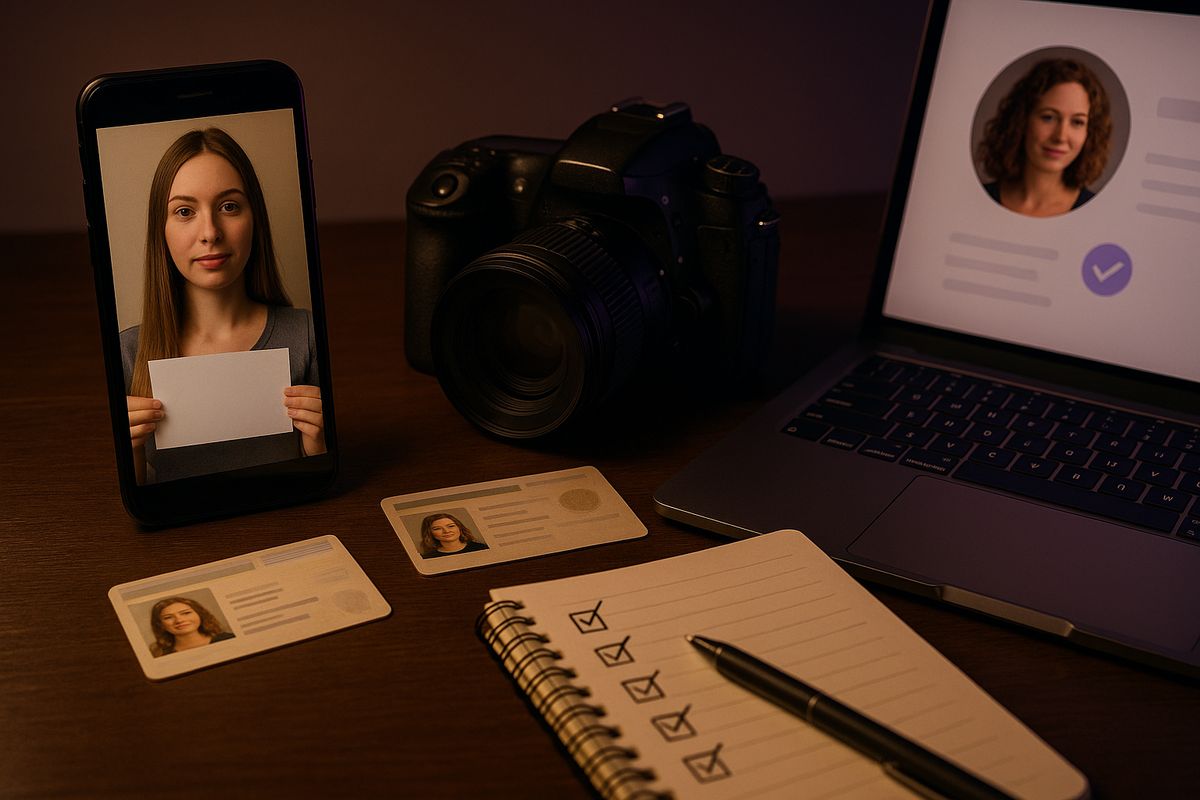
1. Photo verification (selfie with sign or reference)
The most common method. The advertiser submits a selfie holding a piece of paper with information specific to the platform, the date, or a unique reference number.
How it looks in practice:
AdultWork asks for a photo holding the current day's newspaper plus a reference number, with both hands visible. The verification photo expires three days after the date on the paper, and moderation typically completes within 24 hours.
Tryst. link asks for a selfie holding a sign with the working name, the date, and the line "I am signing up for Tryst. link." Tryst keeps the photo internal and never publishes it.
Smooci combines photo verification with community voting, where other users can flag profile photos as inaccurate.
What it proves: the person in the selfie is the person currently active on the account. What it does not prove: anything about age, criminal record, or whether the body shots match the face.
Want to see how a moderated, verified-by-default platform feels in practice? Browse escort ads on Erowave, where every listing is checked by our moderation team before going live.
2. ID and document verification
A stricter model. The advertiser submits a scan of a passport, national ID card, or driver's licence, and a moderator cross-references the document photo with the profile photos.
How it looks in practice:
Eros.com requires government-issued ID before a profile goes live.
Several newer European platforms now require document verification by default, partly because of the UK Online Safety Act and partly because of EU age-assurance pressure.
The privacy question matters here. Under GDPR, platforms operating in the EU must collect only what they need, store it securely, and delete or anonymise documents after the verification check is complete. A platform asking for an ID scan should tell you exactly how long it is stored and who can see it. If that policy is not visible, that itself is a red flag.
What it proves: real legal identity at the moment of check. What it does not prove: that the photos are current, or that the advertiser is who shows up at the meeting.
3. Age verification (AI-based)
Age verification is a separate question from identity verification, and in 2026 it is the one driving the most rapid change in the industry. The trigger is regulation: the UK Online Safety Act now requires highly effective age assurance for adult content, with Ofcom enforcement powers including fines up to £18 million or 10% of global turnover. Ofcom is actively investigating dozens of adult-content services.
The most common technical approach is facial age estimation. Yoti, one of the leading providers, uses AI trained on facial-image data to estimate a user's age from a selfie. The image is processed in seconds and then deleted; no data is stored on the user's behalf.
How it looks in practice:
Skokka uses Yoti age estimation plus mobile number validation in 26 countries.
Several UK-facing adult sites have rolled out Yoti, Persona, or AgeVerification.org integrations since the OSA enforcement deadlines.
Important distinction: age verification confirms you are old enough to view the content. Identity verification confirms you are who you say you are. They are different checks, and a platform might do one without the other.
4. Video verification
Less common but rising. The advertiser submits a short video (or completes a live video call with a moderator) holding the verification sign or speaking a phrase chosen by the platform.
Why it matters: video is much harder to fake than a photo. Industry data from Midnight Penthouse suggests roughly 94% of fake or scam profiles refuse video verification when asked. Even a polite request to confirm a profile with a short video clip is one of the cleanest red-flag tests a user can run.
What it proves: a real, present, moving person matching the profile. What it does not prove: that the meeting itself will be safe or that the service description is accurate.
5. Social and cross-platform verification
The softest layer. Advertisers link their profile to other public accounts that already have followers and history: a verified Twitter or X account, an OnlyFans page, references from other providers in a P411-style system, or independent reviews on community sites such as TER or PunterNet.
These signals work as supporting evidence, not as proof. Social accounts can be fake, references can be reciprocal, and reviews can be planted. Use them as one data point among several.
How the verification process actually works behind the scenes
Most users only see the badge. The work happens upstream.
From the advertiser's side
The typical flow:
Create the account, upload profile photos and description.
Submit a verification photo or ID document, usually within a moderated dashboard.
Wait for moderator review. Standard turnaround is 24 to 72 hours, though some platforms now complete photo verification in under an hour.
Once approved, the verification badge appears on the live profile.
Common rejection reasons include blurry photos, the sign held in the wrong position, expired ID, a mismatch between the verification selfie and the profile photos, or missing watermarks.
When Sara, an independent advertiser in Berlin, first tried to verify her profile on a major directory in late 2025, her first three submissions were rejected. The newspaper in her selfie was three days old; the platform required the current edition. Her second attempt was the right newspaper but her hand covered the date. The third was rejected for poor lighting. The fourth went through within 18 hours. Her booking rate roughly doubled in the following month once the verified badge appeared. Friction at the verification stage is annoying, but it is doing real work.
From the platform's side
Behind every verification badge is a mix of:
Manual moderation. A human reviewer compares the selfie to the profile gallery and looks for inconsistencies, signs of duress, or evidence of underage involvement.
Reverse image search. Automated tools check profile photos against known scam databases, stock photo libraries, and other adult-site profiles. Roughly 78% of fake profiles are caught at the application stage through this kind of check, according to industry data.
Continuous monitoring. Verified profiles can lose the badge if they are flagged by users, if photos change without re-verification, or if the platform sees suspicious behaviour patterns.
This is also where moderation policy matters. A platform that watermarks photos at upload makes stolen-image fraud harder. A platform with an active reporting system can re-check a profile within hours if users flag it. None of this is visible from the badge alone, but it shapes how much that badge is worth. You can read about our moderation approach in our FAQ if you want to see one example of how this is handled.
How to verify an escort ad yourself before you book
Even the best platform verification covers identity at one moment in time. The most useful skill you can develop is your own pre-booking check. Run this six-step list every time, regardless of the platform's badges.
1. Look at the badge, then read what it actually means
Click the badge on the profile. A serious platform will explain what "verified" required: photo, ID, age, video, or some combination. If the platform does not explain what its own badge means, treat the badge as decorative.
2. Run a reverse image search
Save two or three of the profile photos and run them through Google Images or TinEye. You are looking for:
The same photos appearing on stock-photo sites.
The same face on profiles in different cities with different names.
The same face on social accounts with a completely different identity.
A single match on a sister site in the same network is normal. Five matches across unrelated sites in five cities is not.
3. Cross-check independent reviews
Search the working name on independent review sites and community forums. You are not looking for unanimous praise; you are looking for consistency. If the profile has a year of activity history with steady, varied reviews from different reviewers, that is a strong positive signal. If reviews appear in bursts of three or four within a week and then nothing, that pattern often indicates manipulation.
4. Test the communication
Send a polite, specific message. A professional reply is on-topic, prompt without being instant, and confirms basic logistics without pressure. Red flags include:
Demands for full payment upfront.
Refusal to confirm location specifics that should be easy.
Replies that sound copy-pasted across messages.
Pressure to move the conversation to a sketchy platform before any basic detail is agreed.
5. Check pricing realism
About 89% of fake profiles in 2025 industry data were priced 30% to 50% below local market rates. A rate that is dramatically below the local floor is the single most reliable scam indicator. Real advertisers know their market.
6. Ask for one more confirmation
A polite request for an additional photo or a short video clip with a small handwritten sign costs you nothing. Real advertisers usually accept; scam profiles almost always refuse. This is where the 94% video-refusal figure earns its keep.
Ready to apply this checklist? Start with female companion ads on Erowave, then run the six steps before contacting any advertiser. The combination of platform moderation and your own due diligence is much stronger than either alone.
Why escort verification actually matters
Verification is sometimes framed as friction. In practice, it does three things that matter.
It prevents scams
Sextortion, fake bookings, advance-payment fraud, and stolen-photo catfishing all rely on identity opacity. The harder it is to be a fake profile, the smaller the scam pool. When Marcus, a regular user of adult directories in the UK, lost £400 to a deposit-only scam in early 2025, he stopped using any site without visible verification policies. His follow-up pattern, verified platforms plus the six-step check, has run for fourteen months without an incident. That is the entire value proposition of verification in one anecdote.
It is the front line against trafficking
Identity verification combined with age verification is the most practical mechanism preventing platforms from being used to advertise people who are coerced or underage. Organisations such as NCMEC work with platforms to flag exploitation indicators. The UK Online Safety Act, the EU Digital Services Act, and existing FOSTA-SESTA frameworks in the US all push platforms toward harder verification specifically because of trafficking risk. This is not a marketing angle; it is the regulatory baseline.
It protects advertisers, too
The asymmetry of verification is striking. Almost every system verifies the seller of services and not the buyer. Verified advertisers benefit from the reverse-image checks that prevent their own photos from being stolen and used on fake profiles. They benefit from watermarks. They benefit from platform reporting systems that act when an impersonator appears. The badge does work for them as well as for you.

The limits of verification (the honest part)
Here is what verification, even good verification, cannot do.
It cannot guarantee that photos are current. A profile verified six months ago may now use heavily edited or out-of-date images.
It cannot guarantee the service description matches reality. That is between you, the advertiser, and your own communication.
It cannot guarantee legality. Adult-service legality varies by country, region, and even municipality. Verification on a platform tells you nothing about your local law.
It cannot guarantee safety at the meeting. Verified identity is not the same as safe encounter.
It is asymmetric. Almost no platform verifies clients. As a user you are largely anonymous, which is convenient and also limits the protection a verified advertiser has from you.
The honest position is that verification reduces risk; it does not eliminate it. Treat the badge as one of several inputs, alongside reviews, communication quality, pricing realism, and your own intuition. Anyone selling you "100% safe verified profiles" is overselling.
How Erowave handles verification
So that the picture is complete, here is how Erowave's model fits into the landscape.
Every ad is moderated before it goes live. Our team reviews each new listing manually, the same way that AdultWork or Tryst review verification photos. We do this whether or not the advertiser uses the optional photo-verification flow.
Uploaded photos are watermarked. This deters image theft and makes downstream catfishing harder.
Reports trigger re-checks. Users can flag any ad through the report button on the listing, and our moderation team responds. If you spot something off, contact our moderation team directly.
GDPR-compliant data handling. Personal information is never shared without consent. Verification data is collected for verification, stored only as long as needed, and not used for other purposes.
Multi-channel contact options. Snapchat, OnlyFans, Telegram, and other channels are supported for users who prefer remote contact in the cyber-sex category.
This is one verification model among several. Tryst, AdultWork, Skokka, Smooci, and Eros each have valid approaches with different strengths. The right platform for you depends on your market, your privacy preferences, and the level of pre-booking confidence you want. The rules we apply to ourselves are spelled out in our terms of service.
Frequently asked questions
How does escort verification work?
The advertiser submits a selfie, ID, or video to the platform. A moderator (often supported by automated checks) confirms it matches the profile photos, then publishes a verification badge.
What is the difference between photo verification and ID verification?
Photo verification proves the person in the profile is currently active on the account. ID verification proves the person has a real, government-issued legal identity. Many platforms use one or the other; the strongest use both.
Is age verification the same as identity verification?
No. Age verification confirms you are old enough to view adult content. Identity verification confirms who you are. They use different tools and answer different questions.
Are verified escort directories 100% safe?
No directory is 100% safe. Verification reduces risk, particularly scam and impersonation risk, but it cannot guarantee service quality, legality of a meeting in your jurisdiction, or in-person safety. Always combine platform signals with your own checks.
How long does verification usually take?
Photo verification is typically processed within 24 hours on major platforms. ID verification can take 24 to 72 hours. Age verification using AI tools such as Yoti is often instant.
Does verification protect my privacy as a user?
Verification mostly applies to advertisers, not to clients. Your privacy as a user is protected by the platform's GDPR practices, payment privacy, and your own discretion. Read each platform's privacy policy.
What should I do if I think a verified profile is fake?
Use the platform's report button. Most directories, including Erowave, prioritise verified-profile complaints and will re-check the account within hours.
Final word
Verification is one of the most useful trust signals in adult classifieds, and one of the most misunderstood. The five main models (photo, ID, age, video, and social) each prove something different, and the same word "verified" can mean very different things from one site to the next.
What works in practice is the combination: use a platform that verifies advertisers, watermarks photos, and moderates content, and then run your own six-step check on every profile before you make contact. Reverse image search, independent reviews, communication tests, pricing realism, and a polite request for one more confirmation are the user-side companion to platform verification. Together they reduce risk far more than either does alone.
The honest line is the one to remember. Verification reduces risk. It does not eliminate it. Use trusted directories that explain what their badges mean, do your own due diligence, and report what does not look right. Erowave is one of several legitimate platforms operating in this space alongside Tryst, AdultWork, Skokka, Smooci, and Eros — if its moderated, GDPR-compliant approach fits your needs, browse escort ads on Erowave and run the six-step check on any listing that interests you.
---
Internal Links:
https://erowave.com/escort-ads (browse escort ads, CTA)
https://erowave.com/faq-en (our moderation approach)
https://erowave.com/escort-ads/women (female companion ads)
https://erowave.com/contact (contact our moderation team)
https://erowave.com/terms (our terms of service)
External Links:
https://gdpr.eu/ (GDPR)
https://www.yoti.com/ (Yoti age estimation)
https://www.missingkids.org/ (NCMEC, anti-trafficking)
https://www.gov.uk/government/publications/online-safety-act-2023 (UK Online Safety Act)
Word Count: 2,650